The Coming
Stephen King Three Classic Novels Box Set: Carrie, 'Salem's Lot, the ShiningThe Coming is Margaret White’s recurring name for an anticipated religious future, present in the ordinary routines of her home as well as in her apocalyptic vision for Carrie White. The phrase places domestic labor, isolation, and religious instruction within a larger sacred timetable; after the disaster in Chamberlain, Maine, the novel sets that private religious language against public accounts of catastrophe and scientific speculation about the future.
Domestic routine and religious expectation
At the White home, The Coming is not confined to formal worship. Carrie White remembers her mother talking about it while they worked in the living room: Carrie sometimes sewed dresses at the sewing table, while Margaret White tatted doilies. That quiet domestic scene makes the belief a recurring part of ordinary life, not merely a doctrine reserved for services.
The household’s routines also stood in contrast to the world beyond it. Margaret White worked at the Blue Ribbon Laundry in Chamberlain, where she had been employed since Carrie was five, after compensation and insurance from her father’s accident began to run out. Margaret regarded the laundry as godless and described its foreman, Elton Mott, as destined for a special place in Hell. The Coming thus belongs to a worldview that interprets everyday institutions through religious judgment, even as Margaret depends on one of them for her livelihood.
A private church
Margaret White and Ralph White had once been Baptists, but they left the church after deciding that the Baptists were doing the work of the Antichrist. Worship thereafter took place at home. Margaret held services on Sundays, Tuesdays, and Fridays, which the household called Holy Days; she was the minister and Carrie the congregation. The services lasted between two and three hours.
This arrangement gives The Coming a specifically domestic setting. Carrie grows up not simply hearing her mother’s beliefs but occupying the sole congregational role in a closed religious system. The expectation of a sacred future is therefore bound to Margaret’s authority over the household and to the repeated rituals through which that authority is exercised.
Carrie as an instrument of apocalyptic belief
Near the end of Carrie’s life, the religious language of her upbringing appears in her understanding of what Margaret wanted from her. As Carrie struggles on after being wounded, she thinks that she has kept going for her mother, who wanted her to be the Angel’s Fiery Sword. The passage associates Margaret’s expectation with destructive purpose, but does not specify the object of destruction in the fragment presented here. It nevertheless shows how the household’s religious vision could cast Carrie not only as a daughter but as an instrument in a larger, violent design.
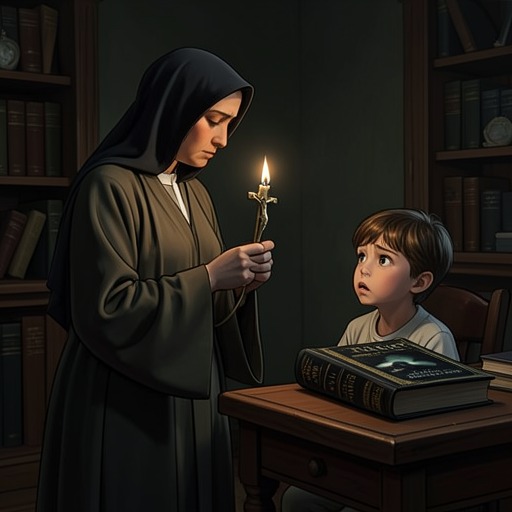
The image makes the gap between Margaret’s religious framework and the consequences of the story especially stark. The Coming is voiced within a private system of worship, while the disaster’s effects become public and are interpreted by people who do not share that system. The novel leaves the religious expectation in place without presenting it as a complete explanation of the events.
After catastrophe: public and scientific futures
Retrospective accounts shift attention from religious expectation to the problem of explaining what has happened and anticipating what may follow. In The Shadow Exploded, David R. Congress discusses the theory that telekinesis may emerge in moments of extreme personal stress, presenting Carrie’s ability as a potential that earlier observers failed to recognize. Another commentator compares the destruction of Chamberlain, Maine, with the assassination of John F. Kennedy, emphasizing how mass media made both events unavoidable in public consciousness and how each marked an ending that had also set something irrevocably in motion.
The book’s closing commentary turns explicitly toward the future. It calls the Carrie White affair over, then raises the prospect of identifying the TK gene and testing school-age children. Against Margaret White’s religious anticipation, this post-disaster language offers a different kind of coming: not a promised sacred reckoning, but a possible scientific and political response to a newly recognized human capacity. The contrast leaves the term’s significance unresolved, while showing how competing beliefs and institutions try to name what lies ahead.